Arturia Memory V Review: A Polyphonic Memorymoog With FM Up Its Sleeve
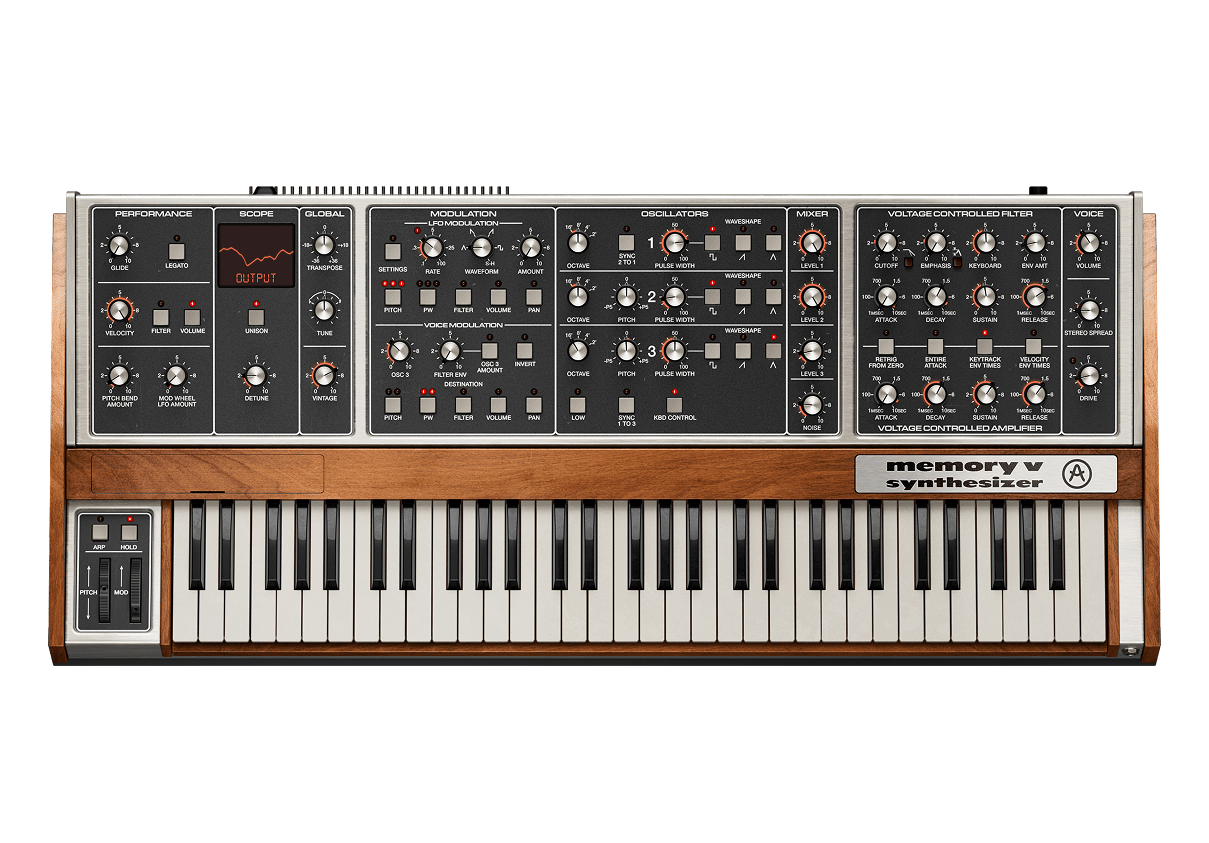
The interesting question with any new Arturia V instrument is never “is it an accurate emulation.” They have been good at that for years. The interesting question is whether the software version gives you something the hardware never could, because if it doesn’t, you may as well chase the real thing and live with the tuning drift. I spent the week with the Arturia Memory V, their take on the Moog Memorymoog, and the short version is that it clears that bar comfortably. It is a polyphonic Memorymoog, yes, but the additions, the FM routing off oscillator 3 in particular, are what make it worth opening over the dozen other analogue polys you probably already own.
This is a look at what those additions actually do, where the original sound comes from, and where Memory V sits next to the rest of the collection. The video covers the two patches I built if you want to watch them come together.
What the Memorymoog actually was
Worth a bit of context, because it explains why a software version is appealing in the first place. The Memorymoog was Moog’s last polyphonic synth, built between 1982 and 1985, right before the company went bankrupt in 1987. Six voices, three oscillators per voice, a 24 dB ladder filter on each. People describe it as six Minimoogs in one box, and that is more or less literally true: eighteen oscillators, six filters, the lot, all running at once.
It sounded enormous and it was a nightmare to keep alive. Tuning eighteen analogue oscillators was the kind of job that turned owners into part-time technicians, and clean units now go for serious money. So the appeal of a faithful emulation isn’t nostalgia, it is getting that three-oscillator-per-voice Moog weight in twelve voices that stay in tune and recall instantly. Memory V gives you Poly 12 voicing, MPE, and a modern modulation system bolted onto that classic engine.
The ladder filter, and why bass compensation matters
The filter is the part everyone judges a Moog emulation on, and Memory V models the 24 dB ladder in component-level detail, with a 12 dB slope option and self-oscillation if you want it. That is table stakes now. What I actually care about is the Bass Compensation switch.
If you have spent time with a real ladder filter, you know the trade-off: crank the resonance and the low end drains away. It is baked into the original circuit. For a lead that screams it is fine, but for anything that needs to hold the bottom of a track it is a constant fight. Bass Compensation preserves the low end as you push resonance up, so you can get the aggressive, vocal resonance without the patch going thin underneath. It is the same idea Moog put into recent hardware like the Messenger and the Muse, and having it on tap here means the filter is genuinely more usable than the thing it is modelled on. That is the kind of addition I want from a software version: not a new feature for the sake of the spec sheet, a fix for a real limitation.
Oscillator 3 as an FM source
This is the part that earns the instrument its place. On the Memorymoog, oscillator 3 could act as a modulation source. Memory V takes that idea and opens it right up: you can route an audio-rate oscillator 3, or the filter envelope, independently per voice to pitch, pulse width, the filter, volume, and pan. You can also chain the envelope into the oscillator 3 amount, so the FM shifts and destabilises as a note evolves.
In practice that means a Moog-flavoured poly that does proper FM textures, which is not something you expect from this lineage. The first patch I built in the video leans on exactly this: an evolving FM drone with oscillator 3 running into pitch and filter, synced and detuned, with a pitch delay on the Advanced page for extra movement. Route the FM to pitch and you get bell tones and metallic partials. Route it to the filter and you get those grainy, shifting filter-FM textures that sit somewhere between a synth and a resonator. Spread it across pan per voice and a held chord opens up into stereo on its own, each voice drifting slightly differently.
None of that is what a Memorymoog does, and it is the reason I would reach for Memory V over a straighter clone. The classic Moog character is still sitting underneath, you are just no longer limited to subtractive moves on top of it.
Getting movement out of a single patch
The second patch in the video is a plucky, arpeggiated thing, and it leans on the modulation side. Memory V gives you three modulator slots that can hold envelopes, function generators, random LFOs, voice modulators, and a Mod Sequencer, plus a four-layer Multi-Arp.
The Multi-Arp is where a lot of the life comes from. You can stack up to four independent arpeggiator layers, run them at different rates, and build poly-metric patterns that drift in and out of phase with each other. Stacking fifths and thirds across layers at different speeds, you get counterpoint and constant movement from one held chord, no sequencer drawing required. I used the Mod Sequencer and the voice modulator to randomise pitch per voice on the plucks, which is the trick that stops an arpeggio sounding mechanical. Different voices land slightly differently each pass, and the pattern feels played rather than programmed.
If you have read my piece on sequencing in Zebra 3 you will know I have a soft spot for getting movement out of the modulation system itself rather than a step grid. Memory V scratches the same itch from a different direction: the Multi-Arp does the heavy lifting, and the per-voice randomisation does the humanising.
Where it sits next to the SynthX and the Prophet
Time for the honest bit. Memory V does not have the dual-layer architecture of the SynthX. On the SynthX you can run two distinct sounds playing different arp patterns at the same time, and that is a genuinely powerful way to build a moving patch. Memory V is a single layer, so you do not get that. The poly-metre Multi-Arp gets you a long way toward the same sense of movement, but if stacking two completely different patches is your workflow, that limitation is real and worth knowing before you buy.
On character, Memory V is in similar territory to the SynthX and the Prophet emulation in the collection: comparable quality, different voice. The ladder filter has its own sound, distinct from the Prophet’s, and the FM routing off oscillator 3 gives Memory V more range than the original Memorymoog ever had. So it is not that one is better, it is that they cover different ground. If your palette is already heavy on Prophet-style polys, the Moog ladder plus the FM is a different colour worth having.
Is it worth it?
If you have V Collection X, this is an easy yes, it is a solid addition and you already own it. As a standalone at around the $149 mark, the question is whether you want a Moog-flavoured poly with FM in your arsenal. For me the oscillator 3 routing is the thing that justifies it, because that is the part you cannot easily get elsewhere. A straight Memorymoog clone would be a harder sell when there are already plenty of analogue polys about. This one does more than recreate, and that is the difference.
FAQ
What is the Arturia Memory V based on? The Moog Memorymoog, a six-voice polyphonic synth Moog built between 1982 and 1985, with three oscillators and a 24 dB ladder filter per voice. Memory V recreates that engine and extends it to twelve voices with a modern modulation system.
What makes Memory V different from a straight Memorymoog clone? Mainly the FM routing. Oscillator 3 can be sent per voice to pitch, the filter, volume, pan and more, which gives you bell tones, filter-FM textures and per-voice stereo spread the original could not do. The bass-compensated ladder filter and four-layer Multi-Arp also go beyond the hardware.
How is Memory V different from the Arturia SynthX? Memory V is a single-layer instrument, so unlike the SynthX you cannot run two distinct sounds on different arp patterns at once. Sound-wise they are comparable in quality but different in character: the Memory V has the Moog ladder filter and FM routing, the SynthX has its dual-layer architecture.
Do you need V Collection to use Memory V? No. Memory V is sold on its own as well as inside V Collection X. If you have the collection it is included.
Last word
If you want the quick version, watch the video: I build the FM drone and the multi-arp pluck from scratch, so you can see exactly how the oscillator 3 routing and the Multi-Arp behave. If you want to grab it, it is on Plugin Boutique here. Have a play with oscillator 3 into the filter first, that is the bit that made me sit up. Let me know what you build. Cheers.