Mixing bass with distortion so it translates on small speakers
Notes
I just got back from ADE in Amsterdam. Monday and Tuesday I was at Soundcation with Dennis Shepherd for a mixing and mastering lecture and a sound design lecture. One point from the mixing session is worth writing down: mixing bass with distortion so a sub still translates when the playback system cannot reproduce that frequency.
That is the video above. Bitwig project, Polymer sine sub, Spek for most of the demo, then a few other tools that do the same job.
The problem with a pure low sine
The sub in this track is Polymer on a sine, amp envelope smoothed a little. There are already a few harmonics from the Sallen-Key filter, but it is still mostly a single low frequency. In the studio it sounds weighty. On a set of speakers that cannot play that frequency, you have nothing left and the bass falls out of the mix.
A quick G1 test tone makes the same point. If the listener's system chops that band off, the note is gone.
That is part of why I layer bass. A mid layer with harmonic content higher up still gives you the feeling of the bass line even if everything below 100 Hz is missing. Distortion on the sub is another way to get there without building a second part.
Distortion on bass generates the missing harmonics
For a sine that does not already have mid content, the clean fix is to generate frequency content higher up the spectrum. Distortion does that. You are not trying to make the bass louder for the sake of loudness. You are adding upper harmonics so the tone cuts through and sits in the mid-range, which is where a lot of mix interest actually lives.
It does not need to be extreme. Enough drive to restore a bit of mid presence is usually enough.
Spek: Classic WaveShaper, Auto trim and the new AGC
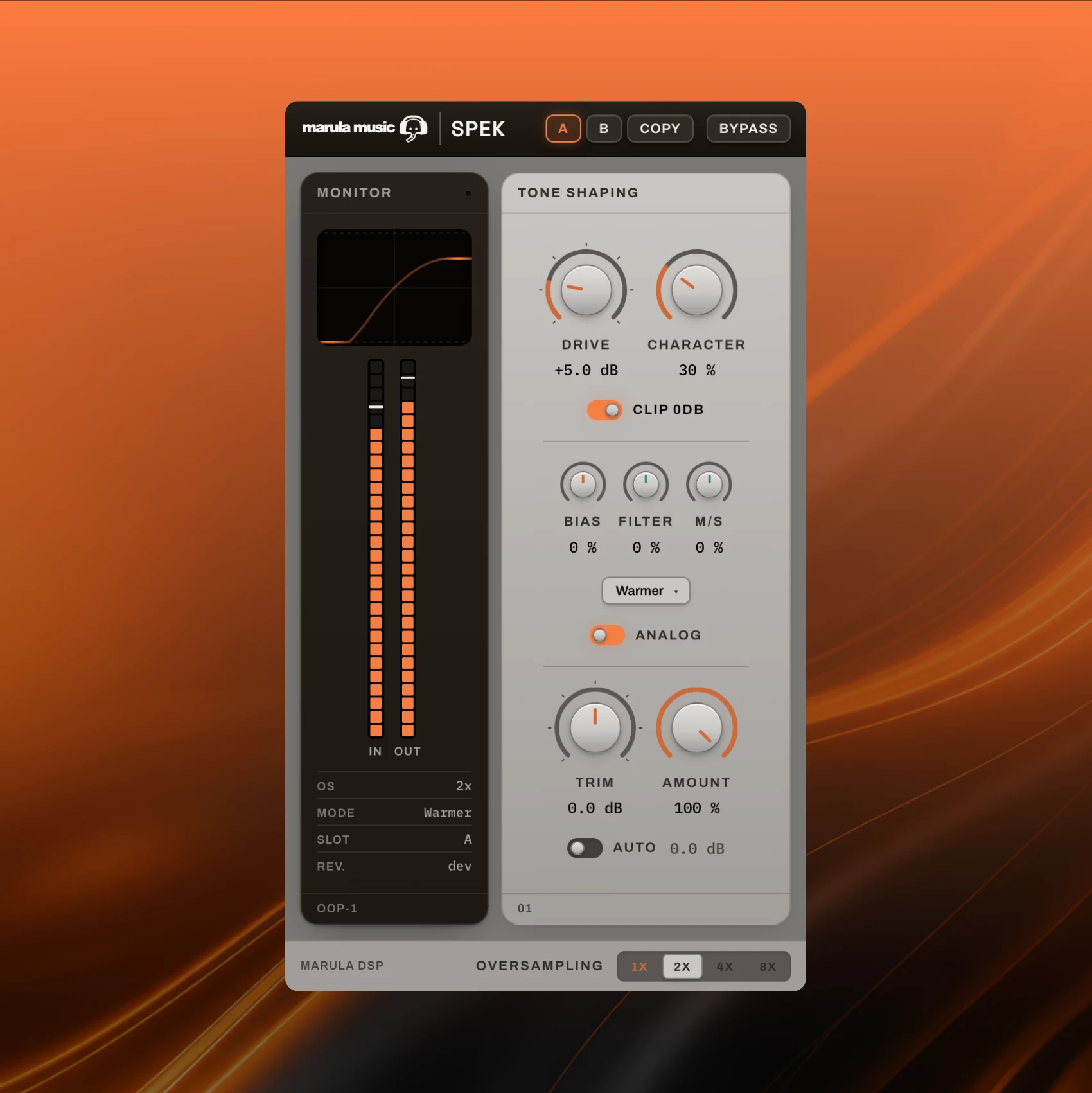
Spek is the tool I reach for when I want this to stay subtle. Classic WaveShaper is the transparent option for me. Warmer (I called it Warmo in the take) gives a woollier colour if you want that instead.
We recently added AGC, dynamic auto gain control. That is different from Auto trim. Auto trim sets the trims from the drive amount; it does not keep input and output level matched as you move. AGC does. Turn AGC on, drive the sine, and what you hear is the tone changing, not a level bump. If you prefer static trims, turn AGC off, note the level and match the output by hand (in the take I landed around -3.8 dB on that pass).
On the Polymer sine, a little Spek drive fills in harmonics above the fundamental. Bypass it and the sub gets lost again in the mid-range. Put it back and the bass pops without sounding smashed.
Other ways to do the same job
You do not need Spek for this. Same idea, different tools:
Freqport Freak Tube. I had the hardware on the desk. Digital mode, pleasant when you push it. Same result: extra harmonics, and the bass sits up in the mix. I will cover more of that unit soon.
Bitwig Saturator. Stock option. Same job.
Bitwig Filter+ with Heat. Disable the filter and use Heat. That moves into wave shaping and wave folding. Folding is a kind of distortion, but saturation is usually subtler for this use. You can also fix some of this at the sound design stage with folding before you touch a mix bus.
Arturia Coldfire. Another bass in the same project used Coldfire the same way. Useful if that is what you already have open.
Sound design instead of mix distortion
You can add those harmonics without any distortion plugin by changing the waveform. In Serum 2, the additive view makes it obvious: strip the partials and you are back to a sine; rebuild diminishing harmonics and you get a saw. Same upper frequencies, baked into the oscillator.
That is often why I use a saw for a bass body while keeping a cleaner sub underneath. Sound choice decides how the bass sits before you reach for saturation. A secondary mid layer with stereo width also helps, because those frequencies already live where small speakers can play them.
Putting it back in the mix
On this unfinished track, a little Spek on the Polymer sub is the difference between the bass disappearing and the bass reading with the rest of the arrangement. I am using distortion on bass here for translation rather than colour: upper harmonics so the low end survives small speakers.
Spek details and the trial are on the Spek page. Project files and extras go up on Patreon when I have them, and the newsletter on the site has free wavetables and sounds.
FAQ
Do I need Spek to mix bass with distortion?
No. Spek is what I used in the video because Classic WaveShaper stays transparent. Bitwig Saturator, Filter+ Heat, Coldfire, Freak Tube, or a saw instead of a sine all get you upper harmonics.
Will distortion on bass ruin my headroom?
If you match level, no. Spek's AGC keeps input and output aligned while you drive. Without AGC, trim by hand so you are hearing tone, not loudness.
Is layering bass better than saturating a sine?
They solve related problems. A mid layer already has higher content. Distortion on a pure sub generates that content from one voice. I often do both.
Why not just turn the sub up?
Level does not invent frequencies the speaker cannot play. Upper harmonics do.
Where is the project from the video?
Not up yet. When I put anything with it, it will sit on the Patreon and the site. The newsletter still has free wavetables and sounds if you want something to start from.