Got it. Here is a formal, objective product description focused entirely on features and functionality.
Melbourne Instruments Roto-Control
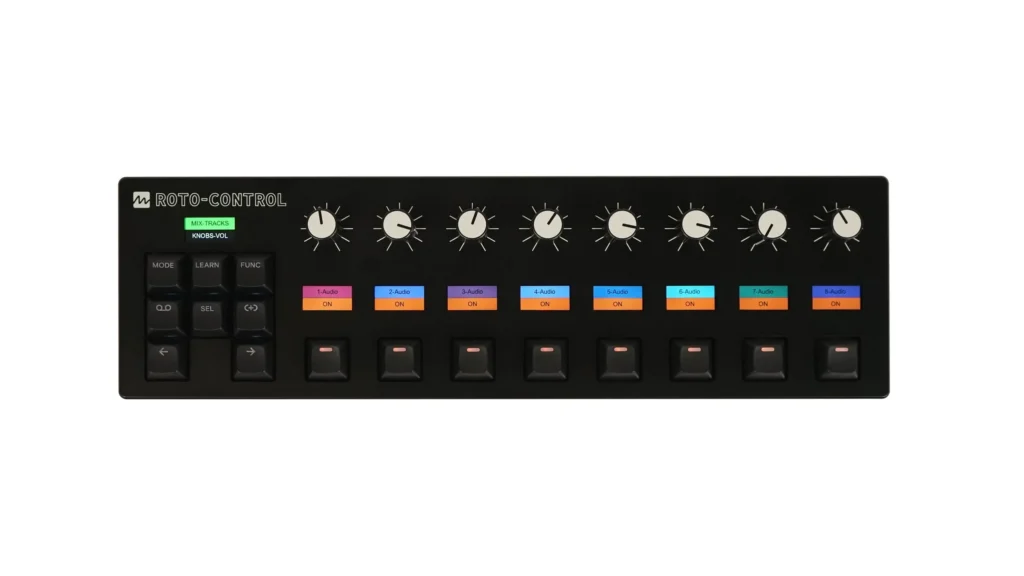
The Melbourne Instruments Roto-Control is a desktop MIDI controller engineered to integrate tactile hardware control with software-based workflows. Utilizing the motorized, haptic encoder technology originally developed for the NINA and Delia synthesizers, the Roto-Control offers true parameter recall and dynamic physical feedback across DAWs, plugins, and external MIDI hardware.
Key Features
- Motorized Haptic Encoders: The unit features 8 touch-sensitive, motorized knobs powered by brushless drone motors. These encoders physically rotate to instantly reflect current parameter values upon changing tracks or loading presets, eliminating value jumping. The haptic feedback is dynamic; the physical feel of the knob changes based on its assigned function (e.g., smooth rotation for volume, a center detent for panning, or discrete mechanical clicks for stepped selectors).
- High-Resolution Visual Feedback: The controller is equipped with 9 high-resolution IPS LCD screens. These displays automatically sync with host software to show track names, parameter labels, real-time values, and track colors.
- Multi-Mode Operation: The Roto-Control functions across three dedicated modes to suit various production stages:
- MIX Mode: Provides native, plug-and-play integration with Ableton Live, Logic Pro, and Bitwig Studio. It automatically maps to mixer functions including volume, panning, and effect sends.
- PLUGIN Mode: Features a touch-and-learn mapping system for VSTs and effects. The device stores up to 64 custom plugin layouts internally, allowing mappings to persist across different projects and computer systems. It also includes native support for Max by Cycling ’74.
- MIDI Mode: Operates as a standalone controller for external hardware synthesizers, drum machines, and lighting equipment without requiring a computer connection, storing up to 64 custom MIDI setups.
- Onboard Motion Recorder: Users can capture and loop physical knob movements. The recorder supports up to 8 parameters per setup, with adjustable lengths from 16 to 64 steps, and playback options including forward, backward, and ping-pong modes.
- Hardware Controls: Alongside the encoders and screens, the interface includes 16 RGB-backlit, tactile buttons dedicated to transport controls, mutes, solos, and track arming.
Technical Specifications
- Connectivity: Dual USB-C ports (one dedicated to data, one for 5V power required by the motors).
- MIDI I/O: Standard 5-pin DIN MIDI In, Out, and Thru for direct hardware integration.
- Dimensions: Approximately 13.4″ x 4.4″ (desktop-friendly footprint).
- Weight: ~1.5 lbs.